
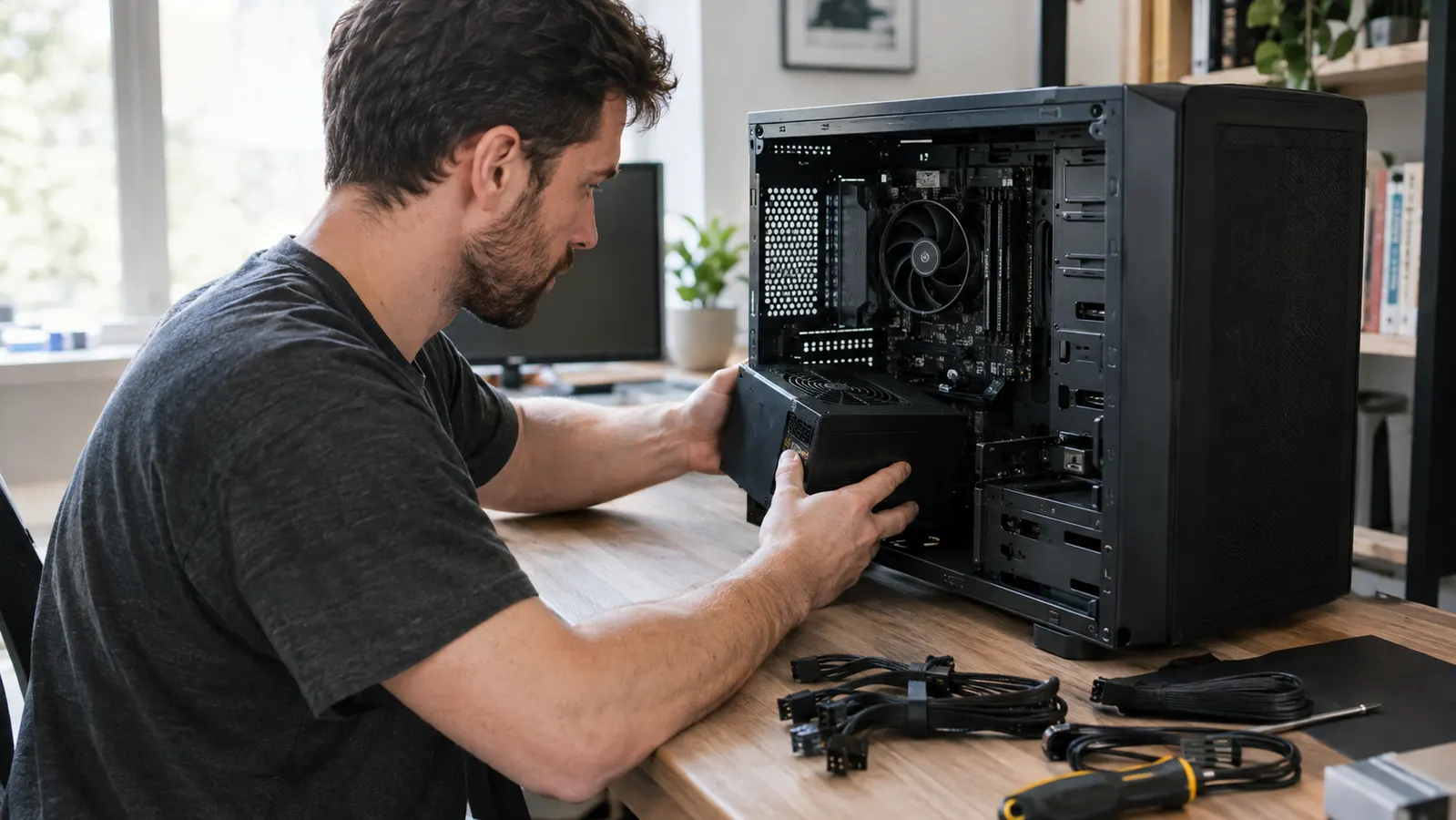
I have built and upgraded gaming PCs for about twenty years, and in all that time I have never seen a dead power supply take out a whole system gracefully. They do not go quietly. They take the motherboard with them, sometimes the GPU, sometimes the drives. The part people are most tempted to skip is the one part that can cost you the whole machine. A quality unit like the Corsair RM750e is the difference between a hiccup and a funeral. My own rig is a mid-tower I built myself, and I upgrade it one part at a time rather than replacing it. My desk is a corner desk in a spare bedroom that doubles as my home office, so I notice heat, noise, and cable mess more than most people. About two years ago, a friend's budget PSU died during a gaming session and took his motherboard and graphics card with it. He had to replace half the machine because he skimped on the power supply. I have not made that mistake since, and I do not want you to make it either. That is the kind of failure that makes people quit building their own PCs, and I have seen it more than once. A quality unit is not exciting, but it is the part that keeps the exciting parts alive.
Protect every part you already own
The Corsair RM750e is the PSU I recommend to anyone building a mid-range gaming PC. Fully modular, quiet, and built to handle today's GPUs without drama.
Amazon Check Today's Price on Amazon →Clean power means stable frame rates
A weak or aging PSU lets voltage ripple through the system. You see it as micro-stutters, random hitches, or a game that crashes only when a big fight scene loads. A quality unit like the Corsair RM750e keeps the rails steady, so the GPU gets what it needs exactly when it needs it. I first noticed this on the unit I had before the RM750e. The symptom showed up in a specific spot: loading into a busy area, the frame rate would hitch for a split second. It was not the GPU, it was not the driver, it was the power delivery. I spent a weekend changing settings, updating drivers, and moving the game to a different drive before I figured it out. After I switched to the Corsair RM750e, that exact hitch disappeared and I stopped blaming my hardware. It took me a while to connect the dots because the game ran fine on the menu and in benchmarks. Real gameplay is where weak power delivery shows up.
It protects the parts you already paid for
A cheap PSU can send a voltage spike straight into your motherboard, GPU, or SSD. That is not a warranty claim, that is a replacement bill. The protection circuits in a quality unit are the cheapest insurance your PC will ever have.
Fully modular cables mean less mess and better airflow
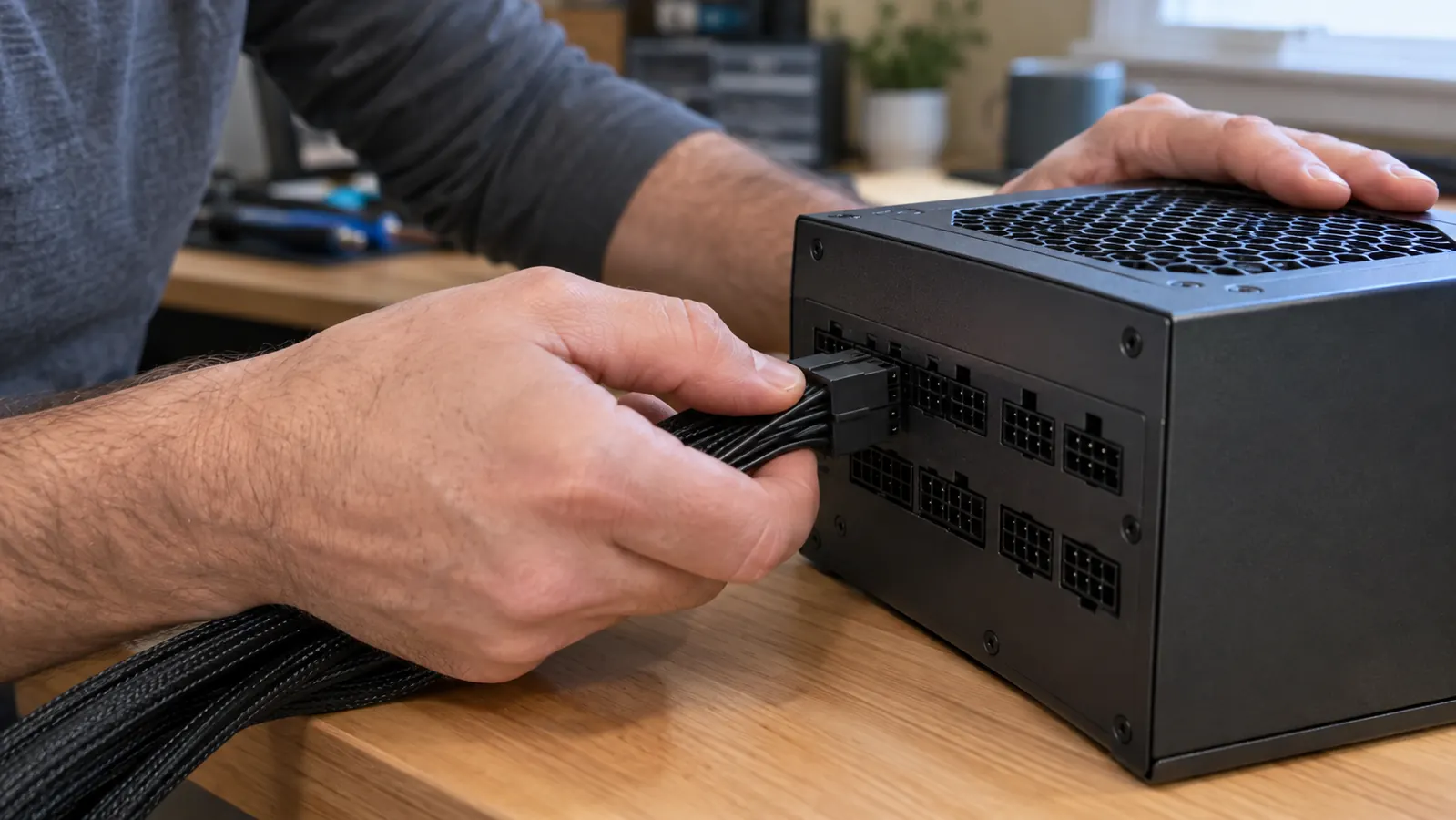
With a fully modular unit, you only plug in the cables you actually need. That means fewer cables stuffed behind the motherboard tray, better airflow through the case, and a side panel that actually closes. My own rig is noticeably easier to work in since I switched. My case has maybe an inch of space behind the motherboard tray, and the first time I built in it, I spent an hour wrestling a tangle of unused cables into place. The back panel bulged and I could not close it without pushing hard. With the RM750e I connected only the 24-pin, the CPU, the GPU, and two SATA cables. The back panel closed without me leaning on it, and the airflow path from the front intake to the rear exhaust is clear. When I swapped in a new GPU last spring, I did it in about forty minutes and most of that was removing the old card. I also appreciate that the RM750e comes with a labeled bag for the spare cables, so I can find the one I need without digging through a drawer.
It handles GPU power spikes without shutting down
Modern graphics cards can pull sudden bursts of power for a few milliseconds. A PSU without enough headroom trips its protection and the whole PC restarts mid-game. The RM750e is built for ATX 3.1 and PCIe 5.1, so it is ready for those spikes instead of surprised by them. I watched this happen on a friend's build with a cheaper unit. The game would run fine for an hour, then the PC would restart right when a fight scene loaded. He assumed it was the game, then the driver, then the GPU. He bought a new graphics card before he figured out the real problem. It was the power supply. The Corsair RM750e includes the 12V-2x6 cable natively, so a modern card connects the way it was designed to, and the unit has the transient headroom to absorb the spike. It is the difference between a game that restarts at the worst moment and a game that just keeps running. The restart happened three times in one evening before he gave up and called me. We swapped in a known good PSU and the same session ran for hours.
Quieter operation than you expect
The fan on a quality PSU often does not even spin at low load. When it does spin, it is slow and steady. My PC sits on a corner desk in a spare bedroom that doubles as my home office, so noise matters to me. The RM750e is one of the quietest units I have used.

Rated capacitors mean it lasts years longer
The RM750e uses capacitors rated for 105°C, which is a fancy way of saying they handle heat without degrading quickly. Heat is what kills electronics. A PSU that runs cooler internally is a PSU that still works five years from now.
Modern Standby keeps wake-from-sleep instant
Older PSUs can make a PC sluggish to wake or slow to enter sleep. The RM750e supports Modern Standby, so the PC sleeps properly and wakes quickly. It is a small thing until you have lived without it.
One PSU can carry you through several upgrades
I upgrade my rig one part at a time rather than replacing the whole thing. A 750-watt unit with modern connectors gives you room for a newer GPU or CPU down the road. Buy the PSU once, upgrade around it for years.
Cybenetics Gold efficiency means less heat and lower bills
Gold efficiency is not just a badge. It means less power is wasted as heat, which keeps your room cooler and your electric bill a little lower. Over a few years of evening gaming, that adds up.
Peace of mind you cannot put a price on
The real benefit of a quality PSU is that you stop thinking about it. No random restarts, no worrying about spikes during a storm, no dread when you install a new GPU. My son Owen plays on the same PC on weekends, and I do not want him learning what a failing PSU feels like.
What I'd Skip
I would skip any power supply that does not list its protections, any unit from a brand you cannot look up, and any deal that seems too good for the wattage. I would also skip buying more wattage than you need. A 750-watt unit is plenty for a single-GPU gaming build. The Corsair RM750e is not the cheapest option, and it is not meant to be. It is the option that keeps working.
A cheap PSU can send a voltage spike straight into your motherboard, GPU, or SSD. That is not a warranty claim, that is a replacement bill.
Give your PC the one part it should never borrow
The Corsair RM750e is fully modular, quiet, and built for today's GPUs. If you are building or upgrading, this is the PSU I would put in my own rig.
Amazon Check Today's Price on Amazon →